
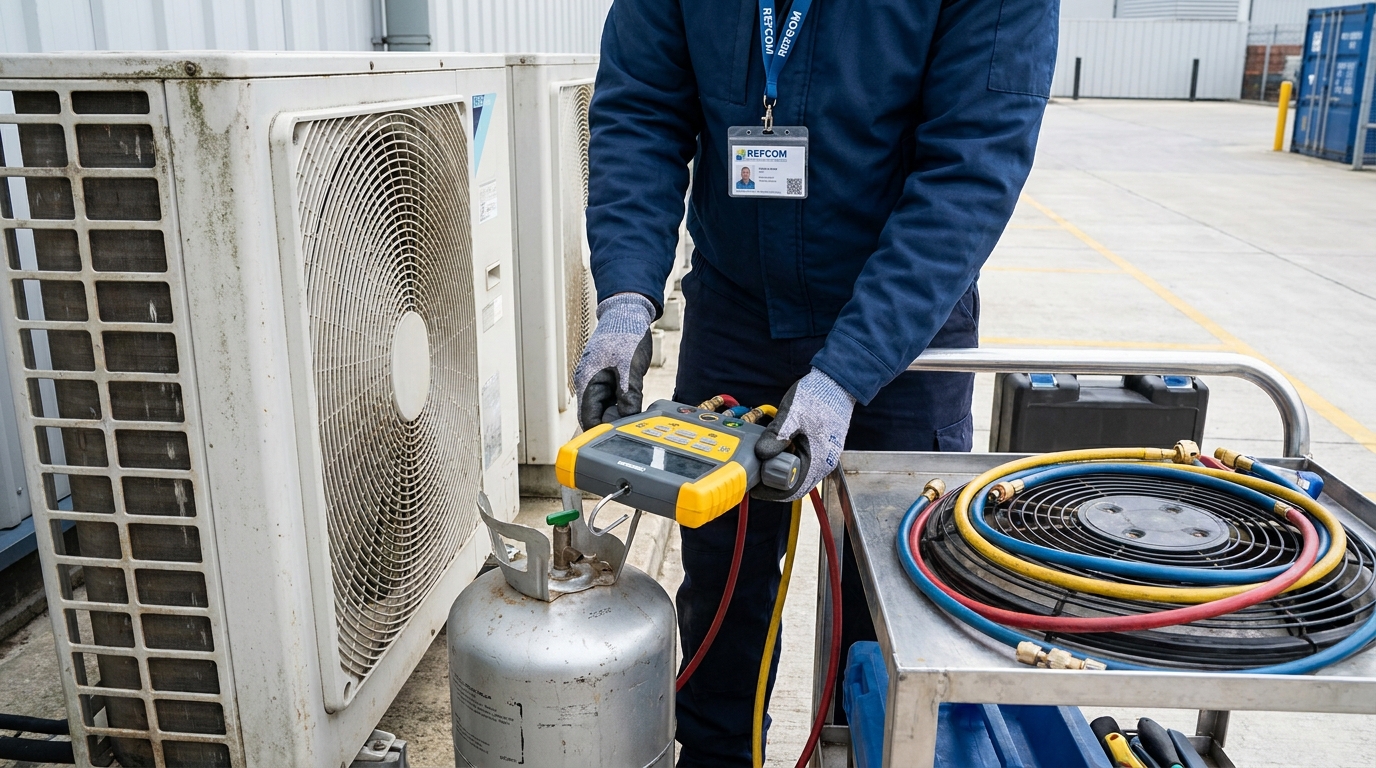
"F-Gas certified" appears on every reputable HVAC company's website — including ours. But most customers have no idea what it means, why it exists, or what it protects them from. Five minutes here and you'll know more about installer compliance than most people buying a £10,000 system.
What F-Gas Actually Is
Fluorinated gases (F-gases) are the refrigerants inside air conditioning, heat pump and refrigeration systems. They're superb at moving heat and harmless while sealed inside the circuit — but released into the atmosphere, they're greenhouse gases hundreds to thousands of times more potent than CO₂.
The UK F-Gas Regulation exists to keep them in the pipes. It controls who may handle refrigerants, how leaks are managed, and how gases are recovered at end of life.
The Key Rules
- Certified engineers only. Anyone installing, servicing, leak-checking or decommissioning refrigerant circuits must hold recognised F-Gas certification (typically City & Guilds F-Gas Cat 1). There's no "small job" exemption for split systems — connecting refrigerant pipework is controlled work, full stop.
- No venting, ever. Refrigerant must be recovered and recycled or destroyed — never released. "Letting it off" to save time on a removal is an offence.
- Leaks must be fixed, logged and rechecked. For systems above threshold charges, documented leak checks are mandatory at fixed intervals. Simply regassing a leaking system and walking away is non-compliant.
- Old refrigerants are being phased out. R-22 is already banned from supply; high-GWP gases like R-410A face quota-driven phase-down, pushing the market to low-GWP alternatives.
Why You Should Care (Even If You Never Touch the System)
- Your warranty depends on it. Manufacturers routinely void warranties on systems installed by uncertified individuals. That bargain quote can silently convert your new system into an unwarranted one.
- The fines can land on you. The Environment Agency can act against businesses that engage uncertified contractors — penalties start around £300 per unit and rise steeply for deliberate breaches. "I didn't know" is not a defence available to commercial operators.
- Property transactions check compliance. Commercial buyers, surveyors and insurers increasingly ask for F-Gas records. Missing paperwork becomes your problem at the worst possible moment.
- Leaking systems cost you monthly. A slow leak means falling efficiency, rising bills, and an unlawful situation if it's known and ignored.
The Good News: Modern Refrigerants Are Better Anyway
Compliance and self-interest point the same direction. R-32 — the standard in current split systems — has roughly a third of the global warming potential of the R-410A it replaces (around 75% lower measured against older blends), and delivers better efficiency per kilo of charge. R-290 (refrigerant-grade propane) goes further still, with a GWP of about 3. Newer systems are simultaneously greener, cheaper to run and cheaper to maintain. There is no trade-off to agonise over.
How to Verify Any Installer in Two Minutes
- Ask for their F-Gas certificate number. A certified engineer will produce it instantly and without offence. Hesitation is your answer.
- Check company registration with REFCOM — the UK's leading F-Gas company register — or the equivalent scheme they name. Company certification matters as well as the individual's.
- Check approved-installer lists. Manufacturers publish accredited installer directories; presence there means the warranty terms are safe.
Red flags worth walking away from: cash-only quotes with no paperwork, "we don't need certification for small units", refusing to name the refrigerant, or offering to top up gas without finding the leak.
Where We Stand
Kelvara operates City & Guilds F-Gas certified engineers, REFCOM registration and full insurance across every job — installation, servicing and decommissioning alike. It's not a marketing line; it's the legal baseline for doing this work properly, and we'll show you the certificates before you ask.
Always hire F-Gas certified engineers
(We are — and we'll prove it.) Get a compliant, warrantied installation with paperwork you can rely on.
Get a Free Quote