
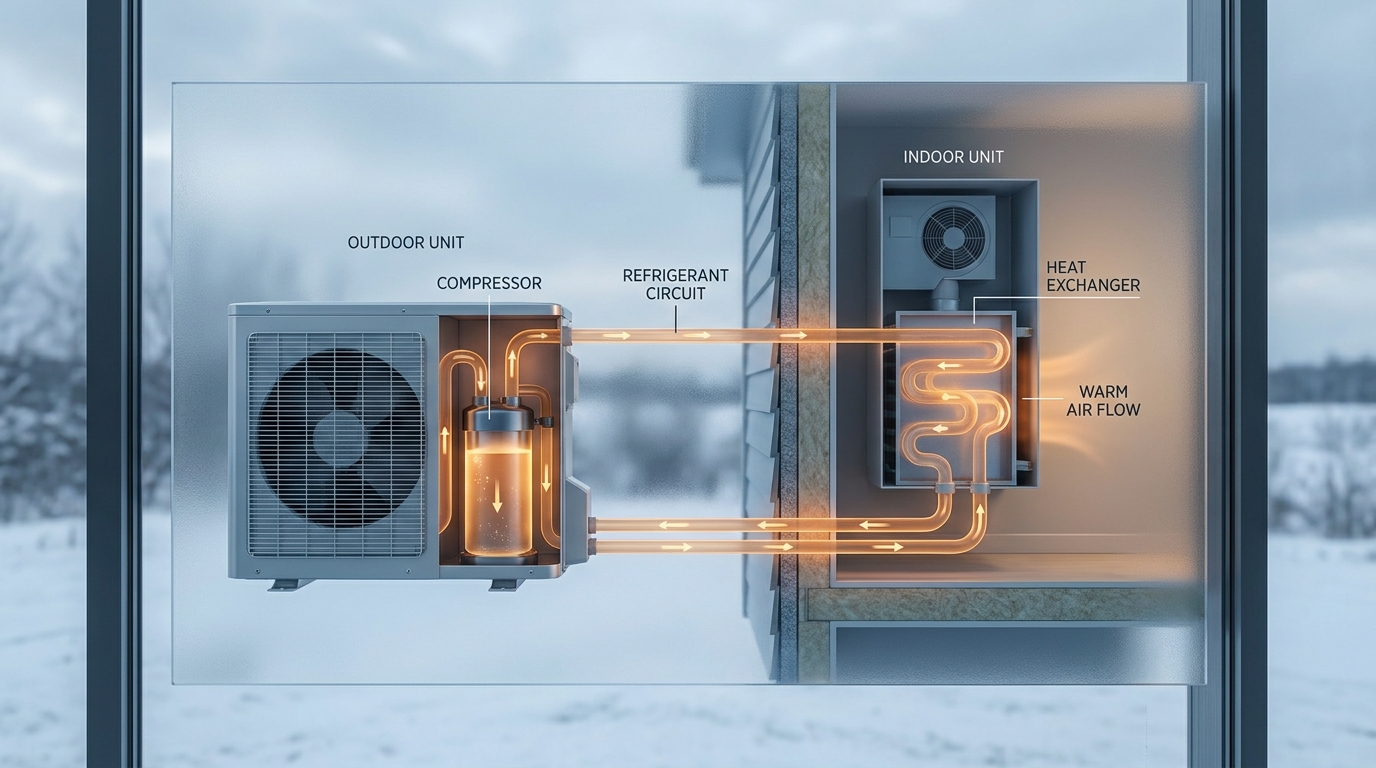
Your neighbours think you're mad for installing a heat pump in winter. "How can it heat the house from cold air?" They're asking a fair question — and the answer is one of the neatest pieces of engineering in your home.
The Myth: "Heat Pumps Don't Work When It's Freezing"
This one refuses to die, so let's kill it properly. Heat pumps are the dominant form of heating in Norway, Sweden and Finland — countries where -15°C is a normal Tuesday. Modern units are tested and rated to operate at -20°C and below. If heat pumps didn't work in the cold, Scandinavia would have noticed by now.
The confusion comes from thinking of "cold" air as containing no heat. It doesn't work like that.
There's Heat in "Cold" Air — a Lot of It
Temperature is a measure of molecular energy, and the true zero point — where molecules stop moving entirely — is -273°C (absolute zero). Air at 0°C is, in absolute terms, still enormously energetic. Even at -10°C, the air outside your house holds vast amounts of thermal energy. It just feels cold relative to your skin.
A heat pump doesn't create heat. It collects that ambient energy and concentrates it to a useful temperature — the same way your fridge pulls heat out of chilled food and dumps it into your kitchen. A heat pump is essentially a fridge running in reverse, with your house as the "kitchen".
The Refrigerant Cycle, Simplified
The magic ingredient is refrigerant — a fluid engineered to boil at extremely low temperatures. Here's the loop, in four steps:
- Evaporation (outside): Liquid refrigerant, colder than the outdoor air, flows through the outdoor coil. Because it's colder than even freezing air, heat flows into it — heat always moves from warmer to colder — and the refrigerant boils into a gas, soaking up energy as it does.
- Compression: The compressor squeezes that gas. Compressing a gas raises its temperature (feel a bike pump after use), so the refrigerant leaves the compressor hot — typically 60–80°C.
- Condensation (inside): The hot gas flows through the indoor coil, where it's now much hotter than your room or radiator water. Heat flows out into your home, and the refrigerant condenses back to liquid.
- Expansion: The liquid passes through an expansion valve, its pressure drops sharply, and it becomes cold again — ready to collect more heat outside. The loop repeats.
Even at -10°C, there's usable heat in the air. The refrigerant inside the outdoor coil can run at -25°C or colder — so heat still flows from the "freezing" air into the system. That temperature difference is all the physics needs.
Why This Beats Burning Fuel
A gas boiler converts fuel to heat at, at best, around 90% efficiency — you can never get more energy out than the fuel contains. A heat pump plays a different game: the electricity it consumes drives the compressor and fans, but the heat it delivers mostly comes free from the outdoor air.
The result is a Coefficient of Performance (COP) of typically 3 to 4: for every 1 kWh of electricity, you get 3–4 kWh of heat. In efficiency terms, that's 300–400%.
| Heating system | Efficiency | Energy out per kWh in |
|---|---|---|
| Electric resistance heater | 100% | 1.0 kWh |
| Modern gas boiler | ~90% | 0.9 kWh |
| Air source heat pump | 300–400% (COP 3–4) | 3–4 kWh |
COP falls as outdoor temperatures drop — there's less energy density to harvest and defrost cycles kick in — but a well-specified modern unit still delivers a COP of 2 or better in a UK cold snap. And UK winters are mild by heat pump standards: the average South East winter day sits between 2°C and 8°C, comfortably in the efficiency sweet spot.
When Heat Pumps Work Best (and When They Struggle)
They excel when: the property is reasonably insulated, the heat emitters (radiators or underfloor heating) are sized for lower flow temperatures, and the system is designed by someone who did a proper heat-loss calculation rather than guessing.
They struggle when: they're bolted onto a leaky, uninsulated property with undersized radiators and asked to behave like a gas boiler. The technology gets blamed; the design was the problem. This is why the survey matters more than the brand on the box.
The Bottom Line
Heat pumps aren't magic and they aren't hype. They're mature, proven thermodynamics — a way of moving three or four units of free ambient heat with one unit of paid electricity. Sized and installed properly, they're the most efficient way to heat a UK property, and they cool it in summer too.
Wondering if a heat pump makes sense for your property?
We'll assess your space honestly — including telling you if it's not the right fit yet.
Get a Free Assessment