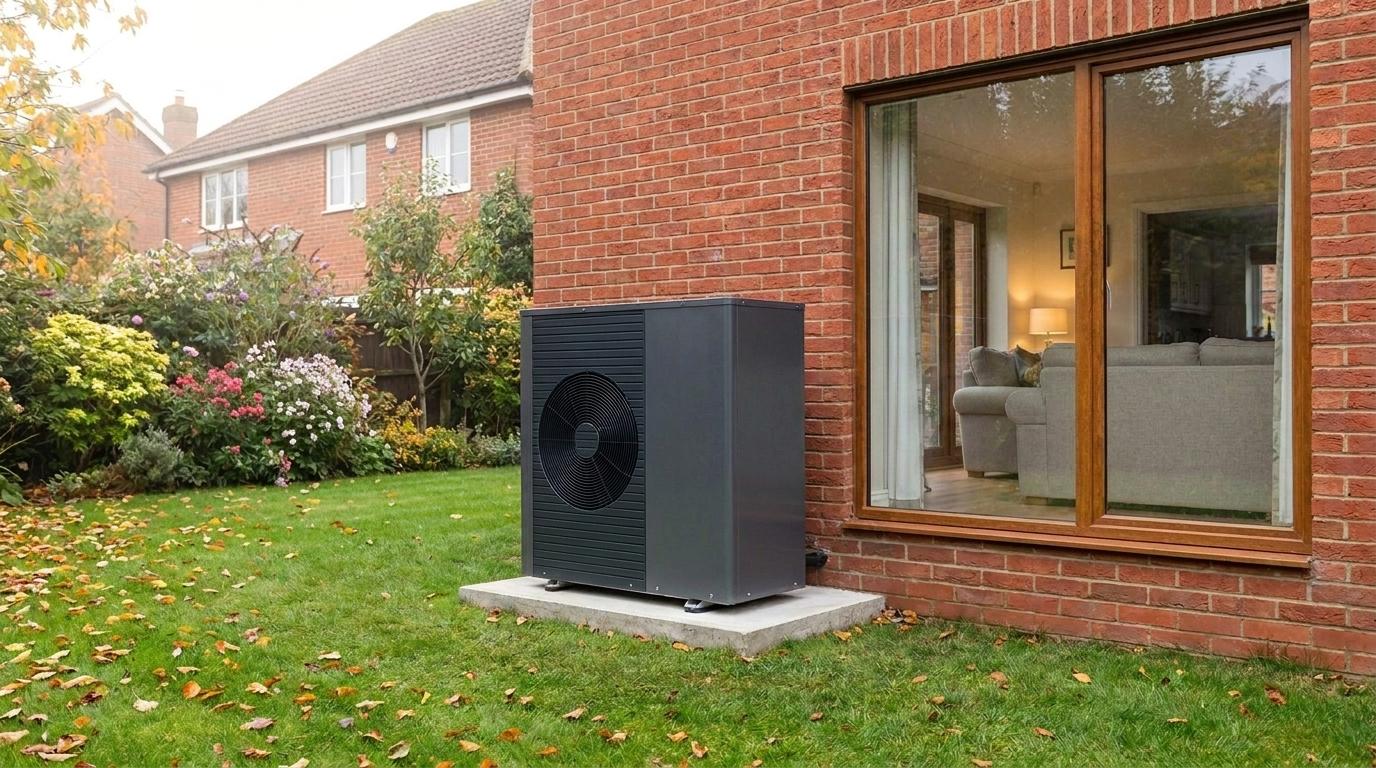
Air source heat pumps are surrounded by more confident claims than almost any other product in the building trade — some of them from people who would like to sell you one, and some from people who would rather you didn't buy one. Both camps tend to skip the part that actually decides the outcome, which is whether your specific building suits the technology and whether the system was sized honestly.
This page covers what an air source heat pump does, what we install, how the process runs, and where the government grant sits — written plainly, including the parts that might mean a heat pump is not right for you.
Not sure whether your property suits a heat pump? Ask us before you commit to anything.
Check your suitabilityHow an air source heat pump works
A heat pump moves heat rather than generating it. Outside air passes over a coil containing refrigerant, that refrigerant absorbs the low-grade warmth in the air, a compressor raises it to a useful temperature, and that heat is delivered into your home. It is a fridge running backwards, and it is the same underlying technology as the air conditioning we install — which is why one team handles both.
Because it relocates existing heat instead of burning fuel, a well designed system typically returns around three to four units of heat per unit of electricity consumed. A gas boiler, however good, cannot exceed one. That ratio is the entire case for the technology, and it is also why sizing matters so much: push a heat pump to run at high flow temperatures because the system was undersized, and the ratio collapses along with the economics.
Air-to-air and air-to-water
Air-to-air systems deliver heat straight into rooms through indoor units, and can cool in summer as well. Air-to-water systems feed radiators, underfloor heating and a hot water cylinder, and are heating-only. They suit different properties and different objectives, and the honest answer for many London homes — especially flats and smaller properties — is that a well-specified air-to-air system does more for them than a full wet-system retrofit.
What Kelvara installs
We install simple and split air source heat pump systems: the outdoor unit, the indoor unit or units, the refrigerant circuit between them, the associated electrical work, and full commissioning. Our RAC15 training covers exactly that — air conditioning and air source heat pump work on split systems. Ground source and geothermal systems are a different discipline and we do not take them on.
We install units from Daikin, Mitsubishi Electric, Panasonic and LG. If you want to compare specifications and efficiency ratings before we visit, Daikin publishes full technical data for its domestic heat pump range, and the other manufacturers do the same. In practice the differences that matter day to day are noise level, controller quality and how well the unit modulates at part load, rather than the headline efficiency figure.
Where a project genuinely needs a full air-to-water retrofit — cylinder, radiator redesign, the lot — we will tell you that straight and point you toward a specialist rather than stretch our scope to fit the enquiry.
How an air source heat pump installation works
Six stages, with the honest conversation about suitability happening at the start rather than after you have paid a deposit.
- 01
Suitability check
A short conversation about the property, how it's heated now and what you want to achieve. We'll tell you early if a heat pump isn't the right answer.
- 02
Survey and heat loss
Room-by-room heat loss calculated against the actual building fabric — not estimated from floor area. This determines everything that follows.
- 03
System design
Unit capacity, outdoor position, pipe routes and controls, plus honest advice on where insulation would do more good than a bigger heat pump.
- 04
Fixed written quote
Equipment, labour, electrical work, commissioning and making good in one figure, with the assumptions written down.
- 05
Installation
Typically one to three days for a simple or split air source system, worked cleanly and with the property left as we found it.
- 06
Commissioning and handover
Full commissioning readings, controls set up properly for how you actually live, and the manufacturer warranty registered on your behalf.
The Boiler Upgrade Scheme — and where we stand on it
The government's Boiler Upgrade Scheme offers eligible property owners in England and Wales a grant of £7,500 toward an air source heat pump. It is paid to the installer and taken off your quote, so you never handle the money yourself. Ofgem's guidance for property owners sets out the current eligibility conditions, which include having a valid EPC without outstanding insulation recommendations, and replacing a fossil fuel heating system rather than an existing heat pump.
An important point of honesty: Kelvara is not currently MCS certified. The Boiler Upgrade Scheme grant can only be claimed through an MCS certified installer, which means we cannot apply for it on your behalf today. If accessing that £7,500 is central to your project, you will need an MCS certified company — and we would rather tell you that now than take a deposit and disappoint you later. We are happy to explain how the scheme works either way, and this page will be updated the moment that certification is in place.
Worth knowing: the grant applies to low-carbon heating, not to cooling. An air conditioning system that also heats efficiently does not qualify, however good it is. The full detail on costs, grants and eligibility is in our heat pump cost and grants guide.
Want the numbers before the sales pitch? Our cost and grants guide has both.
Read the cost guideIs your London property suitable?
Three things decide it, and none of them is the brand of unit.
- Somewhere sensible for the outdoor unit. It needs clear airflow, a position that will not annoy a neighbour, and safe access for maintenance in ten years' time. Terraced houses, mansion block flats and conservation areas each make this harder in their own way.
- A building that holds heat reasonably well. Heat pumps deliver gentle warmth continuously rather than short bursts of very hot water. In a leaky building, that is an expensive way to heat the street. Loft insulation and draught-proofing often return more per pound spent than a larger heat pump.
- Realistic expectations about what changes. A heat pump heats differently to a boiler — steadily, at lower temperatures, and best left running rather than switched on and off. Households that understand that before installation are consistently the ones who are happy afterwards.
Where a property does not suit one, we say so. Sometimes the better outcome is insulation work first and a heat pump in two years' time. Sometimes it is a well-specified air conditioning system that heats efficiently through spring and autumn and cools in summer, for a fraction of the disruption.
Questions
Frequently asked questions
How does an air source heat pump work?
It moves heat rather than creating it. A refrigerant circuit absorbs low-grade warmth from the outside air, a compressor raises that heat to a useful temperature, and it's delivered into the building. Because it's moving existing heat instead of burning fuel, a well-designed system typically delivers around three to four units of heat for every unit of electricity it uses — which is why efficiency figures above 100% are normal here and not marketing.
Do heat pumps work in cold weather?
Yes. There is still usable heat in air well below freezing, and units sold in the UK are rated to operate at around minus fifteen to minus twenty degrees. Efficiency does drop as the outside temperature falls, so a system must be sized against your property's coldest-day heat loss rather than an average — which is exactly why the survey calculation matters more than the brand on the unit.
Is my London property suitable for a heat pump?
The two questions that decide it are whether there's a sensible outdoor position with airflow and maintenance access, and how well the building holds heat. Well-insulated homes suit heat pumps best. Older London stock can work very well too, but often needs insulation improvements or larger emitters first — and a good installer will tell you that before quoting, not after commissioning.
Will a heat pump be cheaper to run than my gas boiler?
It depends on the property and on the gap between gas and electricity prices, which moves. A well-designed system in a reasonably insulated home is often broadly comparable to gas on running cost and substantially lower on carbon. A heat pump dropped into a poorly insulated house and run at high flow temperatures can cost more. Anyone promising guaranteed savings without seeing your property is guessing.
How noisy is an air source heat pump?
A modern domestic unit runs at roughly 40 to 50 decibels a metre away — comparable to a fridge, and quieter than typical London street noise. Siting matters more than the specification: away from bedroom windows, off anti-vibration mounts, and with clear airflow around it. Permitted development rules also set noise limits at the boundary, which we check as part of the survey.
Can one system heat in winter and cool in summer?
Air-to-air systems can do both, which is exactly what a modern air conditioning system is. Air-to-water systems that feed radiators and a hot water cylinder are heating-focused. Plenty of London homes end up better served by a well-specified air conditioning system that also heats efficiently — we'll talk you through both rather than assuming which one you came for.

